Here’s how I would recommend you prepare for the show.
Round 1: The basic strategy is just hitting the buzzer as fast and often as possible. (Make sure there’s no penalty first, but there wasn’t last year!) This is basically quick anagramming of common words that are difficult to practice.
For quick practice, feel free to use something like this list of words that could easily be found on the show. I had made this before I had seen the show, and several words were already on there. (This list isn’t perfect, it has some obscure words and some words that would never make it, but it’s as good as I could make quickly.)
Click here if you want to practice. Let me know if you want a different version. You can easily upload this to Zyzzyva for instance.
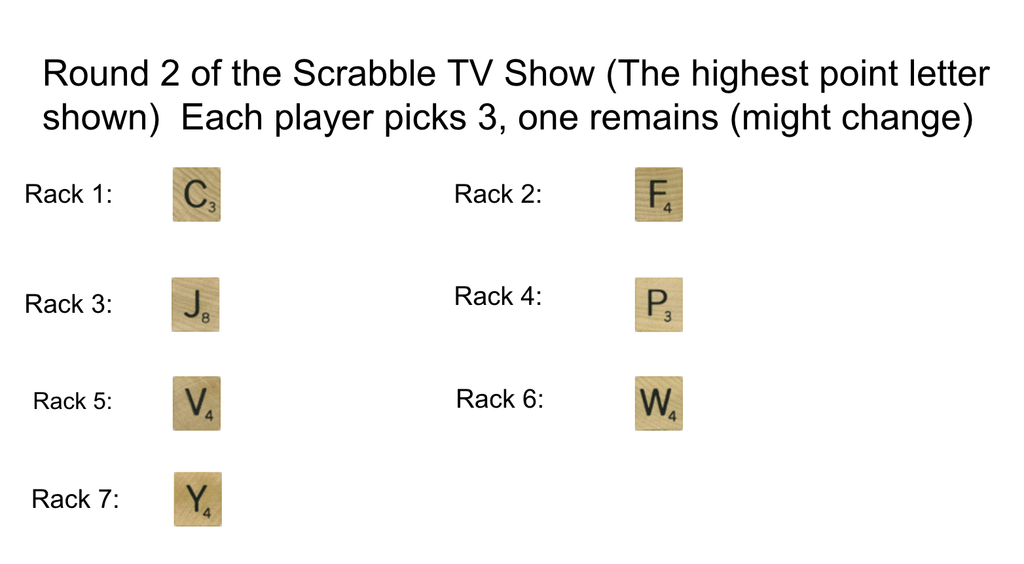
Round 2: If you’re going first, pick the best tiles to go first. If the Z is available, definitely take it. If not, take the J. Anything else is much worse.
While you want to score points, this is largely a more defensive game, especially on the first turn. Scoring is absolutely top priority, but the secondary concern is stopping your opponent from scoring. Played well, this round is extremely luck-based, but you want to play towards the center of the board if possible. Any play that opens the board will likely be shut down quickly. And yet again, these racks are curated. You’re not going to see ACEINRS or PDNRTTT. It’s not going to happen.
For instructional purposes, I’ve created 3 sample Round 2s with the following board:
Round 3:
Round 3: The strategy for Round 3 is the absolute opposite of Round 2, and of most Scrabble: set up literally everything. The pressure will be on. The first thing to remember is that the draws are not random. No one on the show has drawn bingo after bingo, yet no one on the show has gotten racks of 6 vowels or 7 consonants. The draws have been curated to be fairly balanced between vowels and consonants, as well as low and high point tiles. This means you can’t really rely on bingos as much as you otherwise would. Play accordingly. This isn’t Scrabble: don’t worry as much about balance or duplication. Focus on creating as good of a board as you can, and while leave still means something, don’t worry nearly as much about the downsides.
- Play long, and try to reach the corners or edges of the board ASAP. Don’t worry about 2 or 4 points on the first few plays of the game: focus on creating a board where you can chain together scoring plays one after another in scoring spots, parallel or near each other.
- Setup early and often. If the J, Q, X, or Z comes, drop everything to score 50 or 60 for it. If the S comes, look to set up a double or triple word when it makes sense. When you have a scoring play, look for ways to keep a leave that is likely, if not guaranteed, to also score next turn. Try to take one spot at a time while leaving open as much as possible. If you don’t have a good scoring play, then look for a play that creates one, even if, once again, you have to sacrifice some points. 10 or 15 point plays that create multiple good scoring spots really can be a very good idea. This isn’t Scrabble.
- This isn’t Scrabble, so tiles like the R, T, N, I, and E just don’t share the same value as they once did. Unless you’re virtually guaranteed to bingo since you have an amazing 5 tile leave on a wide open board (which shouldn’t happen) or they change the format and ways that they distribute draws, don’t go out of your way to save these tiles.
- Again, look to open the combos. Putting a vowel under or over a double letter-triple word, or triple letter triple word score combo is huge. You still have to score, but it’s pretty easy to create a 40 or 50 point spot. Two of these puts you nearly halfway there. Three of them almost guarantees a win.
Five sample Final Rounds for instructional purposes:
Round 1:
Round 2:
Round 3:
Round 4:
Round 5: